
- Sören Schulze
In recent years, the internationalization of the labor market has gained momentum that goes beyond a mere pattern of globalization. While companies used to send employees on traditional expat assignments, new forms of cross-border work have emerged in recent years.
This article describes the new realities of the labor market, which—influenced by digitalization, demographics, and shifting values—have led to necessary adjustments in established employment models and continue to do so.
Technology Is Shaping New Work Environments
Digitalization has radically transformed the world of work. Tasks that are not tied to a specific production site can now be performed globally. Physical presence is largely no longer necessary thanks to digital collaboration tools, cloud infrastructures, and asynchronous work models.
At the same time, digitalization is driving an increase in more demanding tasks. Repetitive tasks are being automated more and more, and entry-level positions are taken over by AI agents. The resulting dynamics of the labor market pose a challenge, as traditional employment models lose their relevance.
Demographic Change Is Shaping Germany’s Talent Landscape
For decades, Germany has had one of the lowest birth rates in Europe. According to the Federal Statistical Office, the birth rate in 2024 stood at 1.35 children per woman—well below the replacement rate of 2.1 needed to maintain the population. This persistently low birth rate is one of the main factors driving the decline in younger age groups.
Conversely, the proportion of older age groups is rising: currently, those over 65 account for around 21% of the population, and this figure is projected to rise to 29% by 2030. Rising life expectancy and the large cohorts of baby boomers (1946–1964), who will be retiring in the coming years, further reinforce this trend.
In addition to demographic change, we are also seeing a shift in qualifications: whereas training in the past was predominantly in the manufacturing sector, German industry must now keep pace with modern technologies.
So where will the necessary skilled workers come from in 20 years, when both the age structure and the focus of qualifications have changed?
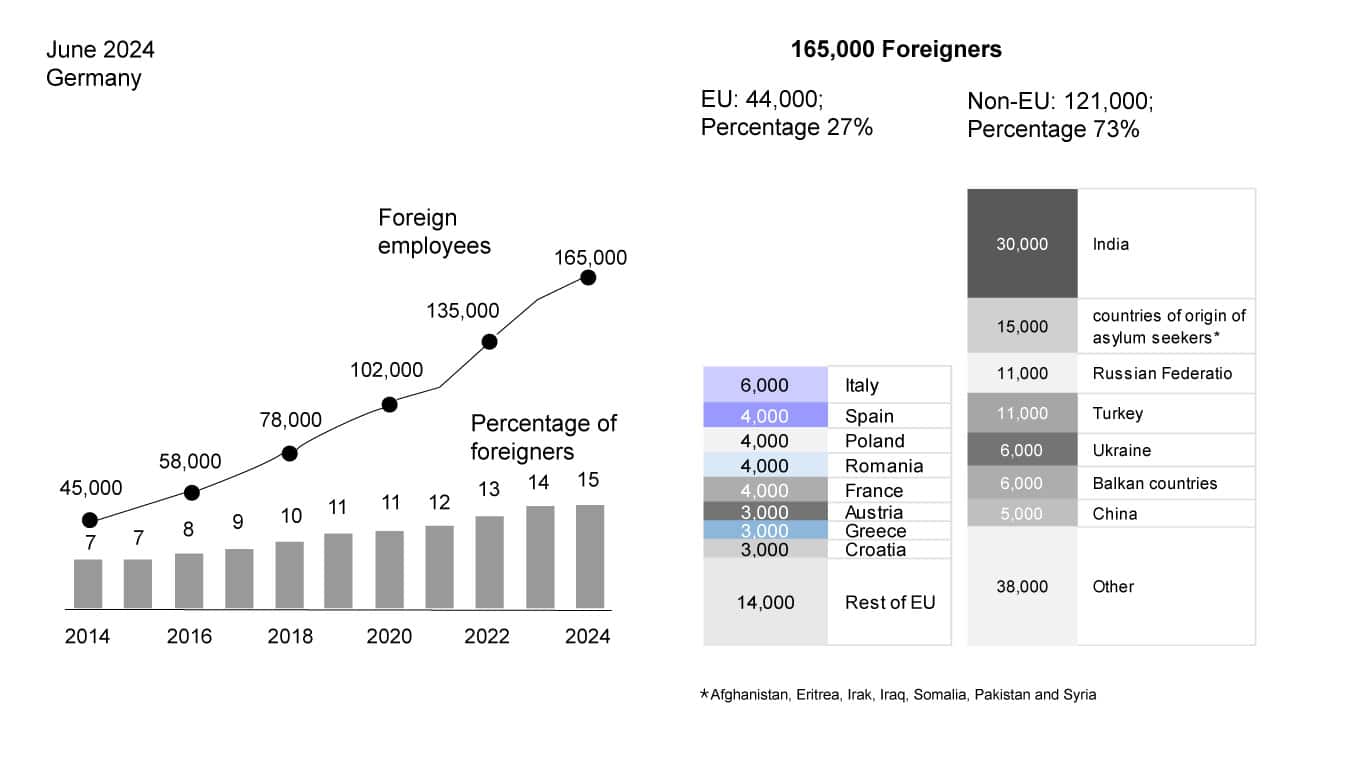
Here, there will be a greater need to attract talent from regions both outside Germany and outside the EU. Policymakers have also recognized this challenge and are currently stepping up efforts to recruit highly qualified professionals from markets such as India or Turkey.
ICT Employees Subject To Social Security Contributions by Nationality
Work Follows Life
In recent years, flexibility, self-determination, and mobility have gained importance. Work is increasingly being integrated into life plans, not the other way around. The ability to decide when and where to work is one of the major employee benefits of the future.
As digitalization enables new work models, concepts such as short-term work in a different location (workation) or a work stay abroad lasting several months (work abroad) are in increasing demand. In extreme cases, the employee is no longer tied to a single location and travels as a digital nomad.
Legislation and social security systems are adapting to this shift in values and the resulting work models. Some nations have distinguished themselves in this regard and created an attractive legal framework, particularly for digital nomads. Over 50 nations already offer solutions for this growing trend (www.globalcitizensolutions.com).
However, this also means that employees who utilize one of these work models must take greater responsibility for private health insurance and retirement planning and can no longer rely on government-provided coverage.
International Assignments in Transition
The question arises: why is an international assignment still relevant to the labor market? While flexible working conditions generally pertain to skilled workers in general, an expat refers to a specific qualification or even a specific individual that an employer needs in another country.
Here, too, the labor market has evolved: while an expatriate employment relationship was the standard for a traditional assignment in the past, cost pressures and stricter visa regulations in some countries have led to localization—that is, a cost-efficient or legally mandated integration into the local social security system with a local employment contract. Service providers have recognized this market and offer local employment through an “Employer of Record”.
All models share the common feature of a temporary assignment and the secondment of an employee—possibly with their family—abroad. Therefore, it is important not only to provide these individuals with appropriate support during their assignment abroad, but also to ensure continuity in their home country or a third country after the assignment ends.
The Labor Market of the Future
The working world of the future is hybrid. Neither workations nor digital nomads will completely replace traditional assignments, and there will continue to be on-site jobs. A mosaic of work arrangements will emerge, the characteristics of which will vary depending on the industry, company size, and individual life situation.
Three trends in the labor market are emerging:
- 1. Greater dynamism: The labor market of the future is increasingly global and dynamic.
- 2. Adapted regulation: There will be further national and international regulations for transnational work.
- 3. More flexibility: Work models will become increasingly hybrid, thereby enabling individual mobility.
This increases the demands on HR managers, both in terms of content and geography. The interplay of technological possibilities, changing demographics, and the international recruitment of talent is becoming more complex. At the same time, this creates new opportunities.
Against the backdrop of changing conditions in the labor market, engaging an internationally positioned consulting firm is becoming increasingly important to find a tailored and sustainable solution.
